Installation Cacti Sur Windows 7
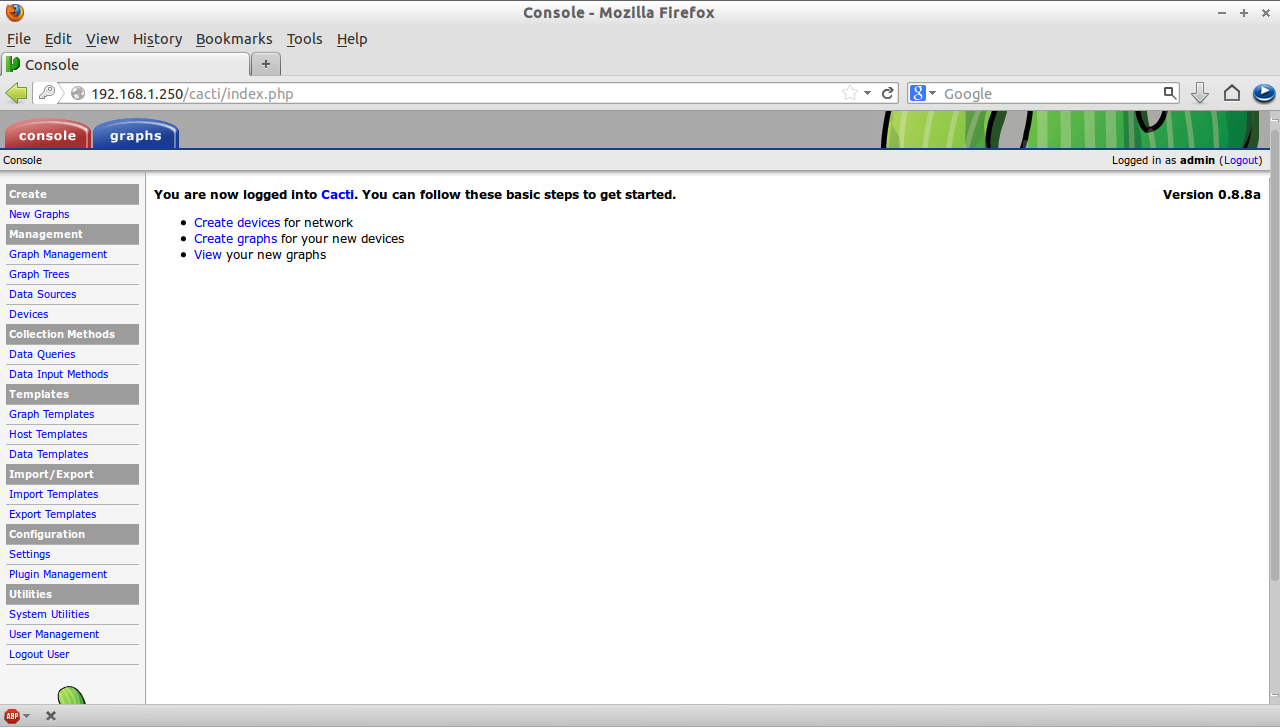
Jun 23, 2017 Overview. Cacti is an open-source, web-based network monitoring and graphing tool used to get a graph data such as CPU usage, memory usage, network bandwidth utilization, and more. It can graph the network traffic by polling a router or switch using SNMP protocol. In this article will show how to install Cacti on CentOS 7 or RHEL 7. How to Install SNMP and Configure the Community String Simple Network Management Protocol (SNMP) is used to by our monitoring system in order to collect detailed information about your server. While configuring SNMP, you may find that certain values are already preconfigured for you.
– Hatiora x graeseri – Schlumbergera x buckleyi – Schlumbergera russelliana x Schlumbergera truncata – Schlumbergera orssichiana x Schlumbergera truncata – Schlumbergera opuntioides x Schlumbergera truncata – Schlumbergera truncata (cultivars) – Cactaceae spp. Colour mutants grafted on the following grafting stocks: Harrisia 'Jusbertii', Hylocereus trigonus or Hylocereus undatus – Opuntia microdasys (cultivars).
Artificially propagated specimens of cultivars of Cyclamen persicum are not subject to the provisions of the Convention. However, the exemption does not apply to such specimens traded as dormant tubers. Artificially propagated hybrids and cultivars of Taxus cuspidata, live, in pots or other small containers, each consignment being accompanied by a label or document stating the name of the taxon or taxa and the text 'artificially propagated', are not subject to the provisions of the Convention.
All parts and derivatives, except: a) seeds, spores and pollen (including pollinia); b) seedling or tissue cultures obtained in vitro, in solid or liquid media, transported in sterile containers; c) cut flowers of artificially propagated plants; and d) fruits, and parts and derivatives thereof, of artificially propagated plants of the genus Vanilla. All parts and derivatives, except: a) seeds (including seedpods of Orchidaceae), spores and pollen (including pollinia).
The exemption does not apply to seeds from Cactaceae spp. “Produced from Hoodia spp.
Material obtained through controlled harvesting and production under the terms of an agreement with the relevant CITES Management Authority of Botswana under agreement No. BW/xxxxxx Namibia under agreement No. NA/xxxxxx South Africa under agreement No. ZA/xxxxxx”. Logs, sawn wood, veneer sheets, including unfinished wood articles used for the fabrication of bows for stringed musical instruments. Logs, sawn wood, veneer sheets, plywood, powder and extracts. Finished products containing such extracts as ingredients, including fragrances, are not considered to be covered by this annotation. All parts and derivatives except: a) seeds and pollen; b) seedling or tissue cultures obtained in vitro, in solid or liquid media, transported in sterile containers; c) fruits; d) leaves; e) exhausted agarwood powder, including compressed powder in all shapes; and f) finished products packaged and ready for retail trade, this exemption does not apply to wood chips, beads, prayer beads and carvings.
All parts and derivatives are included, except: a) Leaves, flowers, pollen, fruits, and seeds; b) Non-commercial exports of a maximum total weight of 10 kg. Per shipment; c) Parts and derivatives of Dalbergia cochinchinensis, which are covered by Annotation # 4; d) Parts and derivatives of Dalbergia spp. Originating and exported from Mexico, which are covered by Annotation # 6.
Seeds, fruits, oil and live plants.
Location Scope SYSCONFDIR/my.cnf Global $MYSQLHOME/my.cnf Server defaults-extra-file File specified with, if any /.my.cnf User. MYSQLHOME is the containing the path to the directory holding the server-specific my.cnf file. If MYSQLHOME is not set, and the server is started with, MYSQLHOME is set as follows:. If there is a my.cnf file in the MariaDB data directory, but not in the MariaDB base directory, MYSQLHOME is set to the MariaDB data directory. Else, MYSQLHOME is set to the MariaDB base directory.
Location in Windows On Windows, my.ini can be used as well as my.cnf, and MariaDB looks in the following locations. Location Scope Windows System Directory Global Windows Directory (WINDIR) Global C: Global INSTALLDIR Server INSTALLDIR data Server%MYSQLHOME% Global defaults-extra-file File specified with, if any. Windows System Directory is the Windows System Directory, usually C: Windows System. Windows Directory is the Windows directory, usually C: Windows.
To find its specific value on your system, use: C: echo%WINDIR%. INSTALLDIR is a directory, one level up from mysqld.exe, for example, C: Program Files. MYSQLHOME is the containing the path to the directory holding the server-specific my.cnf file. My.cnf hierarchy MariaDB will look in all of the above locations, in order, even if has already found a my.cnf file, and it's possible for more than one my.cnf file to exist. For example, you can have a my.cnf file in /etc/mysql/my.cnf with global settings for all servers, and then another my.cnf file in the user's home directory, /my.cnf, which will add further (or overwrite) settings specific only to that user. Note that if the option is used, only this file will be read (client programs will also read.mylogin.cnf when using the -defaults-file option).
If the file does not exist, an error will occur. If no my.cnf file is found, the default values are used for all variables. See for a full list of all server variables and their default values.
You will most likely also find a sample my.cnf file called my-default.cnf, or, on older releases, my-huge.cnf.sh, my-large.cnf.sh, my-medium.cnf.sh, and my-small.cnf.sh (these are now very dated for modern servers). You can choose one of these appropriate for your type of installation, and copy and use as the basis for your my.cnf file. Configuration syntax and groups The syntax of the MariaDB and MySQL configuration files are:. Lines starting with # are comments. Empty lines are ignored.
A group starts with the syntax group-name. You may have many instances of the same group.!include filename can be used to include other configuration files.!includedir directory can be used to include all configuration files in a given directory. Note that the files are read in alphabetical order. Options prefixed by loose will not produce an error if they don't exist.
A MariaDB / MySQL program can read one or many groups. You can see for each program which configuration files and groups it reads by executing program-name -help -verbose sh mysqld -help -verbose./mysqld Ver 10.2.1-MariaDB-valgrind-max-debug for Linux on x8664 (Source distribution) Copyright (c) 2000, 2016, Oracle, MariaDB Corporation Ab and others. Starts the MariaDB database server. Usage:./mysqld OPTIONS Default options are read from the following files in the given order: /etc/my.cnf /etc/mysql/my.cnf /.my.cnf The following groups are read: mysqld server mysqld-10.2 mariadb mariadb-10.2 client-server galera. The configuration files are scanned once, in the order given by -help -verbose. The effect of the configuration options are as if they would have been given as command line options in the order they are found. You can check which command line optiond a given program is going to use by starting it with the option -print-defaults or using the myprintdefaults program.
Sh./client/mysqldump -print-defaults./client/mysqldump would have been started with the following arguments: -socket=/tmp/mysql-dbug.sock -port=3307 -quick -maxallowedpacket=16M sh myprintdefaults mysqldump -quick -maxallowedpacket=16M All MariaDB programs read, in addition to the common groups, the group with the same name as the program. For example mysqldump reads the group mysqldump. The following general groups are recognized. Group Description client Options read by all clients, like mysqldump client-server Options read by all MariaDB clients and the MariaDB server. This option is MariaDB specific. This is useful for options like socket and port, which is common between the server and the clients client-mariadb Options read by all MariaDB clients mysqld Read by the mysqld server, both by MariaDB and MySQL mariadb Read by the MariaDB mysqld server mysqld-VERSION Read by a specific main version of the mysqld server, both by MariaDB and MySQL. For example mysqld-5.5 mariadb-VERSION Read by a specific main version of the MariaDB mysqld server.
Cacti Sur Windows 7
For example mariadb-10.1 PROGRAMNAME Read by the program programname. Could be for example mysqldump. By using the mariadb-VERSION syntax, one can create configuration files that will work for both MariaDB and MySQL! By convention, server variables have usually been specified with an underscore in the configuration files, and a dash on the command line. You can however specify underscores as dashes - they are interchangeable. Example of configuration file The following is an extract of a configuration that one can use if one wants to work with both MySQL and MariaDB.
Cacti Windows Template
# Example mysql config file.