The Installer Disc Could Not Be Found Boot Camp
Mon, Apr 20, 2015 Over the weekend I wanted to install Windows in a bootcamp partition so the kids can use it to do their Chinese homework. The Chinese homework CD unfortunately only works in Windows so I had no choice!! I guess I could have taken other routes, like installing Windows in a VM or something, but I figure that Mac has this awesome tool called bootcamp, why not use that? Well, how wrong I was! I went through a whole day of head-scratching, temper-inducing, word-cussing, USB-swapping and machine-rebooting exercise of getting Windows installed in the bootcamp partition.
I almost went as far as buying a replacement superdrive for the macbook, but at the end I finally was able to get Windows 7 onto the Macbook. To start, my laptop is a Macbook, Aluminum, Late 2008 (MB467LL/A) with a busted optical drive (superdrive). I originally had Mavericks running on it but before this exercise I wiped it clean and installed Yosemite on it. Because the optical drive is busted, I cannot use the Windows 7 DVD, so I had to do this using a USB flash drive. Below are the steps I took to make this work. I can’t guarantee that these steps will work for you, but it’s probably good as a reference.
Aug 12, 2019 A 64-bit version of Windows 10 Home or Windows 10 Pro on a disk image (ISO) or other installation media: If installing Windows on your Mac for the first time, use a full version of Windows, not an upgrade. For more information about using Windows on your Mac, open Boot Camp Assistant and click the Open Boot Camp Help button.
Having seen a ton of articles on the problems people had with bootcamp, I hope no one has to go through the troubles I went through. It took me a while to figure this out (after reading numerous online posts), if your Mac has an optical drive, Boot Camp Assistant will NOT create a USB flash drive-based install disk. The only way to trick the system to do that is to do the following: (Though it turns out at the end that this step is quite useless, since the USB install disk created by Boot Camp Assistant couldn’t boot! So you could really skip this step.).
Modify Boot Camp Assistant’s Info.plist as described. After the modification, you need to resign Boot Camp Assistant, or else it will keep crashing. To do that, following the instructions. For the impatient, run the command sudo codesign -fs - /Applications/Utilities/Boot Camp Assistant.app.
Start “Boot Camp Assistant”, and select the options “Download the latest Windows Support”, and “Install Windows 7 or later versions”. Note I am not selecting the option to create a Windows install disk. It turned out the USB install disk didn’t boot. I keep getting the “non-system disk, press any key to continue” error, and basically that’s the end. In any case, these two tasks should download the bootcamp drivers onto a USB drive, and also partition the Mac’s HD into two partitions. One of the parititions is the BOOTCAMP partition, which will be used to install Windows 7. Once that’s done, I needed to create a bootable Windows 7 USB Flash drive.
If you search the web, you will find that most people run into two problems. The first is the bootcamp-created flash drive giving the “non-system disk” error, and the second is the boot up hangs with a blank screen and a flash underscore cursor at the top left corner. I’ve ran into both. You will also find some articles that explain how to make the flash drives bootable using fdisk, but that didn’t work for me either. Finally I found that pointed to the. It’s a Windows program that can create a bootable USB flash drive from a Windows 7 or 8 ISO file. Note though, not all the USB flash drives are created equal.
The PNY 16GB drive I used didn’t work. WUDT ended with an error that says it couldn’t run bootsect to create the boot sectors on the flash drive.
The one that worked for me was Kingston Data Traveler 4GB. Now that I have the bootable USB flash drive, I plugged that into the Mac and started it up. This time the installation process got started. When Boot Camp Assistant created the BOOTCAMP partition, it did not format it to NTFS. So the first thing I noticed was that when I select the BOOTCAMP partition, the installer said it cannot be used because it’s not NTFS. The option to format the partition is not immediately obvious, but I had to click on “Drive options (advanced)” and select the option to format the partition. Once that’s done, I encountered another error that says the drive may not be bootable and I need to change the BIOS setting.
Yeah at this point I was pretty ticked and the computer heard a few choice words from me. Doesn’t matter what I do it doesn’t seem to let me pass this point. I did a bunch more readings and research, but nothing seem to have worked. I finally decided to turn the computer off and come back to it.
Magically it worked the second time I tried to install it. I was no longer getting the non-bootable disk error. My guess is that after the NTFS formatting, the installer needs to be completely restarted. In any case, at this point, it was fairly smooth sailing. The installation process took a bit of time but overall everything seemed to have worked. After the installation, I plugged int the bootcamp flash drive with the WindowsSupport files, and installed them.
I am still not a 100% yet. The trackpad still doesn’t behave like when it’s on the Mac. For example, I can’t use the two finger drag to scroll the windows, and for the life of me, I cannot figure out how to easily (and correctly) set the brightness of display. But at least now I have a working Windows 7 laptop!
If you own a Pro chances are pretty good that you’ve investigated something like the OptiBay which lets you replace your optical drive with a second hard disk. After I did a few months ago I started to look at installing a copy of 7 on my Pro for things like League of Legends and the occasional Windows app.
Unfortunately Boot Camp Assistant doesn’t like it when you’ve modified the Pro and there are some other snags that you’ll run into along the way. Through a few hours of trial and error I’ve come up with solutions to the problems that I’ve faced, so it’s time to pass on those fixes to you in hopes that maybe you won’t waste as much time as I did.
Here is my step by step guide to install Windows 7 on. What You Need. A flash drive, 4 GB or larger. A copy of. The. Overview The Boot Camp process is relatively straightforward. The Assistant will download a set of drivers for Windows to install and then it will allow you to select the size of the partition that you want to make.
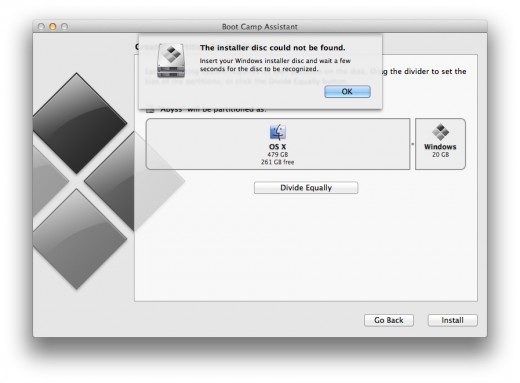
After the partition is created, your machine will restart and the Windows installation begins. From here it’s a matter of clicking Continue a number of times and then you’ll have a dual-booting MacBook. Well, almost. If you have a MacBook Air, Boot Camp doesn’t look for an optical drive. But if you have a MacBook or Mac Pro it will scream at you when you load it up. You can ignore the warning, but the assistant will stop dead in its tracks once you’ve selected your partition size. “The installer disc could not be found” is going to be the message that gives you fits.
So let’s start from the beginning. First, take that ISO of Windows 7 and use Microsoft’s DVD/USB Download Tool to make a bootable flash drive with it. Of what’s going on, but it’s a very simple process.
Make sure you keep a copy of the ISO on your Mac. Once you have that completed, make sure that you have installed Toast.
Locate that copy of the ISO on your Mac and right click it to open the menu, select Services, then use the Mount It option. This will “fool” OS X into thinking that you have a physical optical drive and the Windows 7 disc loaded into it. This is the solution to “The installer disc could not be found”.
While the obvious answer here is to mount the disc image with OS X’s tools, they won’t work because the Assistant knows that you don’t have a physical disc in place. It’s quite possible that there are other ISO mounting apps that will work for this, but I can only verify that it works with Toast. Now that you have the bootable USB and the ISO mounted, start Boot Camp Assistant and follow the steps. You’ll have two options that you can select at first. Make sure that both are checked, and then proceed to the next screen.
On here, select “Save a copy to an external drive” and then click Continue to choose the path that you want to use. You can not save these files to the bootable USB without some prior customization, so I suggest a second USB drive or just saving them to a folder on your desktop. If all goes well, you’ll have a dual-booting installation of Windows 7 on your Mac or MacBook Pro, no optical drive required. Potential Problems There are some snags along the way, and but they’re fortunately quite easy to avoid or work around. The first problem is that Boot Camp Assistant under Mountain Lion does not appear to format the partition to FAT, which is required for Windows to install. Fortunately you can do this yourself during the installation process.
Just select the partition labeled BOOTCAMP and click Format. This does not appear to have any ill effect on your OS X installation, but please make sure you have a current backup in place. You’ll probably think that your computer has frozen during the installation, as you’ll get stuck on a solid gray screen for periods that seem to last longer than they should. On many occasions I had to wait 3 or 4 minutes on these screens before the installer would continue. The next problem you’ll likely encounter is more of a curiosity than a serious issue.
Chances are you’re using a smaller SSD as your main drive, with a large-capacity, spinning drive as your secondary. It would make sense to install Windows to that second drive, but it doesn’t always work. On a couple of occasions it appeared that no master boot record was written to that drive, as opposed to the main drive where it worked every time. Your milage may vary, but I eventually relented into a 20 GB partition on my SSD rather than dealing with the headache of a missing MBR. The final (and perhaps most frustrating) problem that you’re likely to encounter is a Windows error on installation. Chances are it will be “ error 0x8030024” which tells you “Windows is unable to install to the selected location” after you’ve pointed the Windows installer to the partition that you want to use. The problem here seems to lie in having more than one drive active in the system.
Disconnect one of the drives. I know, it’s a pain in the tail, but I can tell you from my experience that it worked flawlessly. Interestingly the Windows installer doesn’t always stall when you have two drives installed, and there doesn’t appear to be any logic to whether it will work or fail.

But if it fails, just disconnect the second drive and restart the installation. Oh, and one last tip – If you find yourself stuck with a bad Windows install, or booting into Windows by default, restart your computer and press the Alt/Option key right after the beep.
Download free il fattore scarpetta pdf merge. Unemployment divergence and unemployment club convergence have been touched on in a large number of works and have recently also been studied using spatial econometric analysis. This book focuses on the questions of how territorial differences in productivity levels and unemployment rates arise in the first place and why territorial differences in labor market performance persist over time.
Keep it held down until you see a menu pop up with the available installations, just as you would to boot into recovery for OS X. So there you have it. It’s not quick, it’s not easy, but if you need to have a copy of Windows 7 on your Pro and you don’t have an optical drive, this method will work. Have problems that I haven’t covered here? Drop them in the comments and let’s see if we can get your questions answered.
The Installer Disc Could Not Be Found Boot Camp In Texas
Image: This post is part of our contributor series. The views expressed are the author's own and not necessarily shared by TNW.